Localized pricing is crucial for apps operating globally. Ignoring exchange rate fluctuations can hurt conversions and revenue by up to 30%. Here's what you need to know:
Localized pricing isn’t optional for global apps - it’s a proven way to protect revenue and improve user acquisition. Use data and automation to refine your strategy and stay ahead.
Exchange rates fluctuate continuously during market hours, reflecting the dynamic nature of global currency markets [2]. While major currencies like the USD, EUR, and GBP float freely based on supply and demand, some smaller currencies are pegged to a base currency by central banks [2]. Under typical conditions, daily rate changes range between 0.1% and 0.5%. However, significant economic events can cause sharp movements, with a currency potentially dropping as much as 5% in just two hours [2]. In such an environment, businesses must adjust pricing strategies to stay competitive and protect revenue.
"Exchange rates are fundamentally different from most data your application handles. They change constantly during market hours, sometimes dramatically within minutes." - APIVerve [2]
These fluctuations stem from a variety of factors, including central bank interest rate decisions, political events like elections or policy changes, economic indicators such as GDP growth and inflation, and global geopolitical developments [2]. In countries with high inflation, like Turkey or Argentina, exchange rates require closer monitoring compared to more stable markets. A devalued local currency can make your app significantly more expensive for users in that region, potentially harming conversion rates.
One of the primary drivers of exchange rate shifts is interest rate differentials. When a central bank raises interest rates, its currency often strengthens as investors seek higher returns. Inflation also plays a critical role; high inflation reduces a currency's purchasing power, leading to depreciation. Geopolitical stability is another key factor - political uncertainty or economic instability can cause rapid currency devaluation.
Using outdated exchange rates during volatile periods can result in significant discrepancies. If the price shown to a user doesn’t align with the actual value received, either the business or the customer absorbs the financial loss [2]. Most businesses aim to keep variances between expected and actual transaction amounts below 1% [2]. Beyond this threshold, discrepancies can become substantial enough to necessitate immediate pricing adjustments.
Understanding these underlying causes helps businesses decide when to update their prices.
To avoid unnecessary adjustments, consider setting a threshold of a 5–10% currency change over a 30-day period before initiating a price review. This approach minimizes "price fatigue" while ensuring that significant shifts are addressed. For stable markets like the EU or UK, quarterly price audits are generally sufficient. However, for more volatile regions experiencing high inflation, monthly reviews are advisable to ensure your pricing aligns with your revenue goals.
It’s important not to rely solely on exchange rates. In cases of high inflation, local users’ purchasing power may not rise in tandem with currency devaluation, meaning a direct price increase could hurt conversion rates. Apple and Google's automatic currency conversions often lag behind real-world conditions, failing to account for local cost of living and purchasing power [3][4]. When adjusting prices, use psychological rounding - rounding to numbers like $9.99 or $14.49 - to maintain a polished appearance and meet consumer expectations [4].
"If your rates are hours or days old, they'll eventually be significantly wrong at exactly the wrong time." - APIVerve [2]
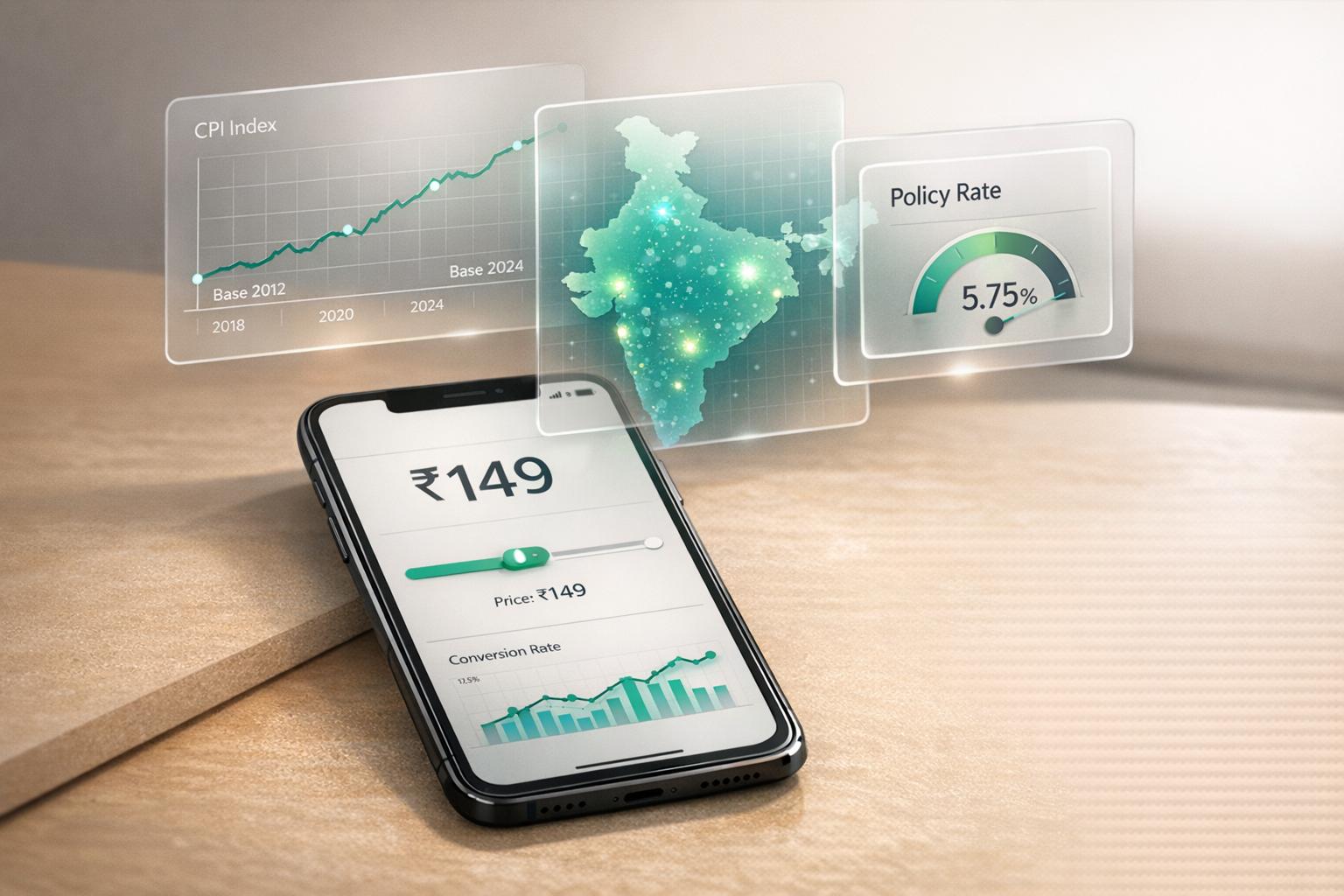
When exchange rates fluctuate, adjusting prices in different regions becomes essential. To fine-tune localized pricing, start by using Purchasing Power Parity (PPP) data from sources like the World Bank, OECD, or IMF. For example, if the base price in the U.S. is $9.99 and the PPP factor for India is 0.25, a logical starting price would be around ₹249.
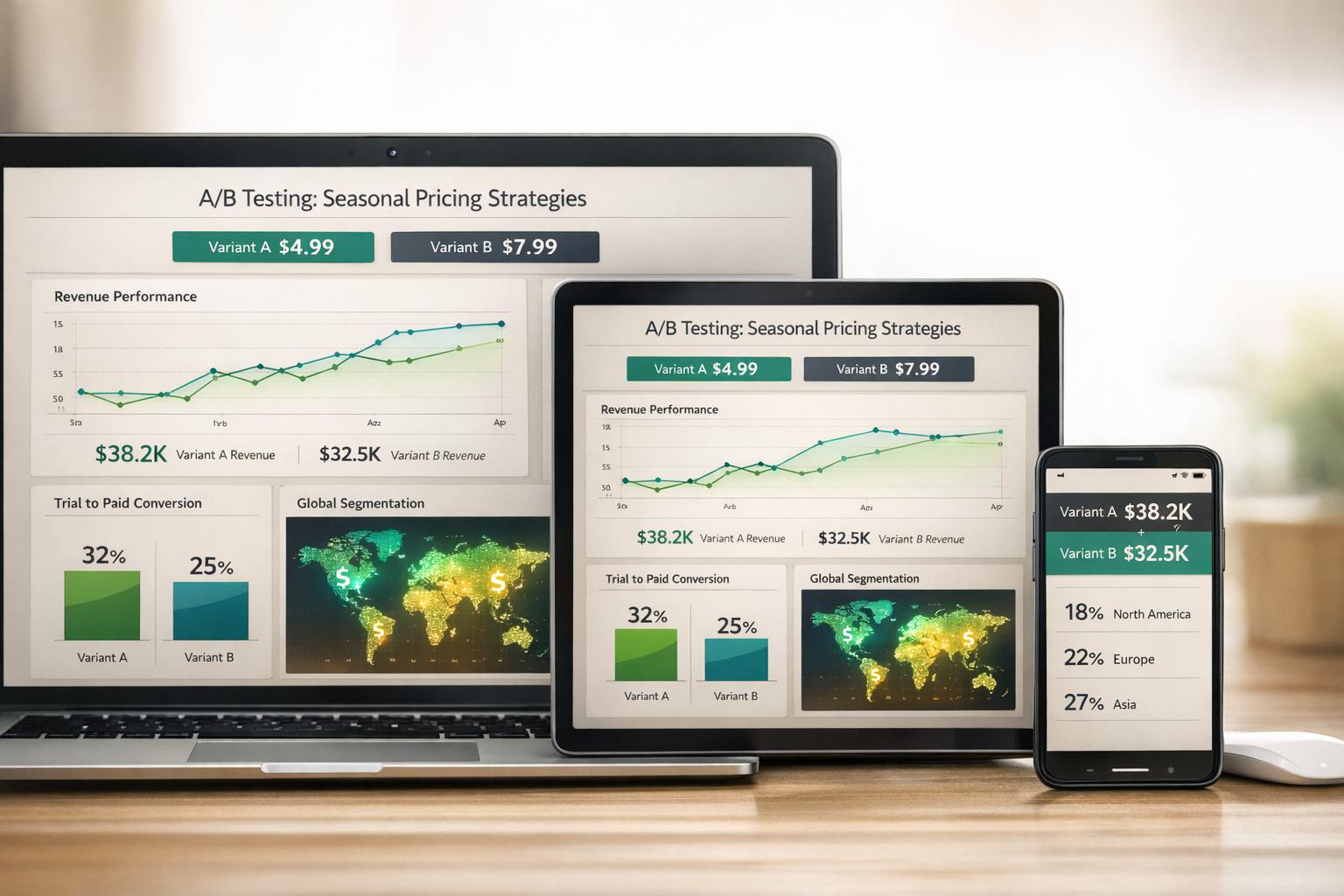
To refine pricing further, conduct regional pricing A/B tests with three variations: the PPP baseline, a 20% premium, and a 20% discounted "volume" option. Track key metrics like revenue per user (RPU), conversion rates, and retention over 7, 30, and 90 days. Gradually roll out the best-performing price variant, starting with 10% of your audience, then 50%, and finally full deployment - keeping 5–10% as a control group for ongoing comparison.
PPP serves as a reliable guide for regional pricing, but combining it with willingness-to-pay testing helps you pinpoint the most effective price points. Run these tests in isolated regions to avoid skewing your results. Platforms like Mirava simplify this process by using real purchasing data from global players like Netflix, Spotify, Apple, and YouTube. Acting as an upstream pricing intelligence tool, Mirava syncs PPP data and calculates price tiers across more than 170 countries. Meanwhile, tools like RevenueCat, Adapty, and Purchasely manage billing and paywalls, ensuring smooth integration.
Psychological pricing can significantly influence buyer behavior. For instance, using charm pricing (e.g., prices ending in .99) can increase sales by up to 24% due to the "left-digit bias" [5] [6]. For premium apps, round numbers like $10.00 convey a sense of quality. Additionally, presenting annual subscription costs as a daily expense (e.g., "less than $0.50 per day") or omitting currency symbols altogether can reduce hesitation and nudge users toward your preferred pricing tier [7].
Both Apple and Google require pricing to align with specific tier formats and comply with regional tax and VAT regulations. To ensure a smooth rollout, phase in pricing changes: begin with a small user segment, verify payment systems, and expand gradually. In regions with stringent consumer protection laws - such as the EU, which mandates a 30-day notice for subscription price changes - provide users with adequate advance warning. Mirava simplifies tax and VAT calculations, while tools like RevenueCat and Purchasely handle the technical aspects of price updates.
Next, we’ll dive into tools that can automate these pricing adjustments seamlessly.
Pricing Tool Comparison: Mirava vs RevenueCat, Adapty, and Purchasely
Managing prices across platforms like the App Store, Google Play, and web can quickly spiral into a logistical headache, especially when exchange rates fluctuate. Instead of manually adjusting hundreds of prices across different consoles, dedicated tools can simplify the process, saving both time and minimizing errors.
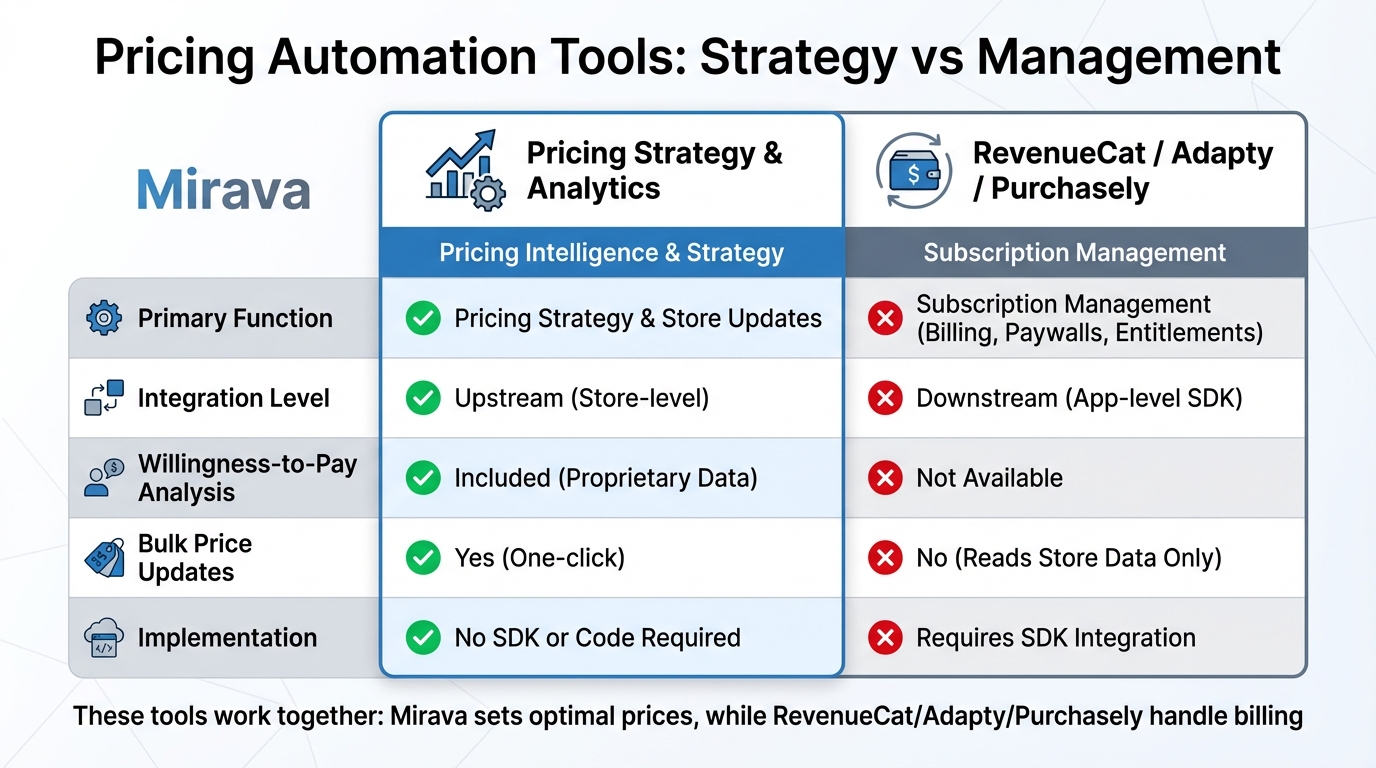
Tools like Mirava focus on determining the right price based on purchasing trends and currency shifts, while platforms such as RevenueCat, Adapty, and Purchasely handle payment processing, paywalls, and entitlements. When Mirava updates pricing, these platforms automatically sync the changes - no SDK or code adjustments required.
Each tool serves a specific role in your monetization workflow. Mirava specializes in pricing strategy, optimizing price points in over 170 countries. It offers bulk updates, analyzes willingness-to-pay, and applies region-specific pricing conventions (e.g., .99 endings in the U.S. versus whole numbers in Japan).
RevenueCat, Adapty, and Purchasely, on the other hand, focus on managing subscriptions. They handle payments, entitlement logic, and paywall testing. These platforms pull pricing data directly from app stores, ensuring your billing setup remains unaffected when Mirava pushes updated prices.
| Feature | Mirava | RevenueCat / Adapty / Purchasely |
|---|---|---|
| Primary Function | Pricing Strategy & Store Updates | Subscription Management (Billing, Paywalls, Entitlements) |
| Integration Level | Upstream (Store-level) | Downstream (App-level SDK) |
| Willingness-to-Pay Analysis | Included (Proprietary Data) | Not Available |
| Bulk Price Updates | Yes (One-click) | No (Reads Store Data Only) |
| Implementation | No SDK or Code Required | Requires SDK Integration |
This division of responsibilities eliminates engineering bottlenecks. Teams can adjust pricing in response to market changes without touching code or disrupting subscription logic. Let’s explore how Mirava brings precision to pricing strategies.
Mirava acts as a central hub for managing SKUs, currencies, and products across iOS, Android, and web platforms like Stripe. It tracks currency changes in real time, flagging when local prices drift from your global pricing framework. This avoids unattractive price points caused by random exchange rate fluctuations.
What sets Mirava apart is its proprietary pricing indexes. Instead of relying solely on GDP or purchasing power parity (PPP), it evaluates actual purchasing trends from global subscription leaders like Netflix, Spotify, and YouTube. For instance, users in Switzerland, Norway, or Singapore often pay 50% to 200% more for subscriptions without impacting conversion rates [1]. This data-driven approach helps capture additional revenue without relying on guesswork.
With Mirava, bulk updates are straightforward: a single click pushes changes to all storefronts, eliminating the need for manual CSV uploads or console adjustments. The platform also applies region-specific rounding rules automatically, such as charm pricing (.99 endings) in conversion-driven markets or clean round numbers (e.g., $10.00) where simplicity is preferred. All updates are subject to manual review to ensure they comply with Apple and Google’s guidelines.
Next, we’ll dive into strategies for communicating these pricing changes effectively to your users.
When price changes are communicated clearly and at the right time, acceptance rates can exceed 70%, while churn can drop by as much as 15%. Customers are far more likely to accept a price increase if they see it as fair and well-explained. In contrast, arbitrary or poorly communicated adjustments result in acceptance rates below 30%. Notably, 98% of SaaS companies that effectively communicate price changes either maintain or improve customer retention rates [8].
It’s important to frame price adjustments in a way that reflects fairness and added value, especially when localizing prices for different regions. For instance, when adjusting for exchange rate shifts, emphasize that your pricing aligns with local subscription norms. Companies like Netflix, Spotify, and YouTube Premium follow this approach to reflect local economic conditions [1]. Because users only see their local price, this reduces confusion across regions [1]. Let’s explore how to effectively communicate these changes to your users.
Start your price change announcement with a straightforward explanation of what’s changing. Use before-and-after comparisons to make the adjustment clear. Follow this with a reason for the change, linking it to product improvements, new features, regional adjustments, or enhanced customer support. This approach helps reinforce the value of your offering, improves checkout conversions, and can reduce churn.
A great example comes from Slack’s 2018 pricing update. They gave customers 90 days' notice and explained that the increase would support platform enhancements. Existing customers were grandfathered into their current rates for a full year, and enterprise accounts were offered tailored migration plans. Slack also created a detailed FAQ page and trained their support team to ensure consistent messaging. As a result, they experienced minimal churn during the transition [8].
Another effective strategy is to protect current subscribers by keeping their rates unchanged while applying new pricing only to new users or upgrades. This approach, used by platforms like Apple and Google, can improve retention by 25% [8]. Clear messaging, combined with this type of pricing structure, builds trust and sets the stage for effective notifications.
Timing and the choice of communication channels are just as important as the message itself. SaaS companies that provide at least 60 days' notice experience 40% less negative feedback compared to those offering less than 30 days [8]. For most B2B SaaS products, aim to notify users 30–60 days in advance, with 90 days being ideal. For enterprise clients, a 6-month notice period may be necessary to accommodate budget planning cycles [8].
Using multiple communication channels is key to ensuring your message reaches everyone. Here’s a breakdown of effective options:
A four-stage email sequence can help ensure clarity and trust. Start with an initial announcement from leadership, followed by a detailed explanation of the impact, then a reminder as the date approaches, and finally a confirmation message. This structured approach keeps users informed and reassured [8].
App store guidelines also play a role in notification practices. On iOS 13.4 and later, Apple automatically displays a message within the app to inform subscribers of price increases [9]. Google Play, on the other hand, notifies users 7 days after a price change and provides a 30-day window for users to accept the new pricing before their subscription is canceled at the next renewal [9].
| Notification Channel | Effectiveness Rate | Key Benefit |
|---|---|---|
| 76% preference [8] | Primary channel for formal documentation. | |
| In-App Notifications | 28% higher awareness [8] | Contextual alerts during product engagement. |
| Direct Outreach | 62% higher acceptance [8] | Essential for enterprise relationship management. |
Lastly, ensure your support team is prepared with clear talking points, scripts that reinforce the value of your product, and options for concessions or alternatives. Companies with robust feedback channels and response protocols retain 53% more customers during price transitions [8].
For mobile app developers aiming to thrive in the global market, localized pricing is no longer optional - it's a critical growth strategy. Flat global pricing often misses the mark; a $29/year subscription might seem reasonable in Switzerland, yet it could be far less accessible in countries like Indonesia. By aligning your pricing with local purchasing power and market norms, you don't just improve conversion rates in specific regions - you unlock greater overall revenue potential.
Pricing decisions should be rooted in data. Track currency fluctuations, use psychological pricing strategies, and benchmark against local competitors rather than relying on simple USD conversions. For instance, users in wealthier countries such as Norway or Singapore often tolerate prices 50–200% higher without significant impact on conversion. Meanwhile, in emerging markets, introducing lower price tiers can lead to substantial revenue growth. This approach underscores the importance of leveraging automation.
Managing pricing across 170+ countries manually is simply unfeasible. Automation tools like Mirava provide a solution by analyzing real purchasing behavior from platforms like Netflix, Spotify, Apple, and YouTube to recommend region-specific pricing. When paired with tools like RevenueCat, Adapty, and Purchasely, which handle billing and paywalls, developers can efficiently manage App Store tiers, currency fluctuations, and user willingness-to-pay metrics.
Apple and Google also ensure that existing subscribers are unaffected by pricing adjustments, meaning localized pricing changes impact only new customers and upgrades. This makes it a low-risk strategy with significant upside. As Mirava aptly states:
"Local pricing outperforms flat global pricing. Every. Single. Time." - Mirava
To determine the right time to adjust local prices after exchange rate shifts, keep an eye on critical indicators such as international traffic levels (typically within the 15-25% range), purchasing power trends, and currency movements. Take action when metrics like conversion rates or revenue reveal a disconnect with local demand. Consistent analysis helps maintain competitive pricing that aligns with local economic realities, ensuring you can optimize revenue even in unpredictable markets.
To tailor local prices effectively, it's essential to look past simple currency exchange rates. Incorporate regional economic factors, such as income levels, purchasing power, and local market trends. By understanding how much users in a specific area can realistically afford, you can set prices that feel fair and accessible. Tools like Mirava simplify this process by monitoring currency fluctuations and analyzing market data. This allows for dynamic price adjustments that can improve conversions, enhance user satisfaction, and drive revenue growth across different regions.
To adjust prices effectively without risking churn or negative reviews, prioritize localized pricing tailored to the economic conditions and expectations of each market. Leverage data to determine region-specific pricing that aligns with local purchasing power. Automate updates to accommodate currency fluctuations, ensuring your pricing remains fair and relevant. Additionally, test various price points to find the optimal balance between revenue growth and user retention. Be transparent when communicating these changes - highlight improvements in value to help users understand and accept the adjustment, preserving trust and satisfaction.