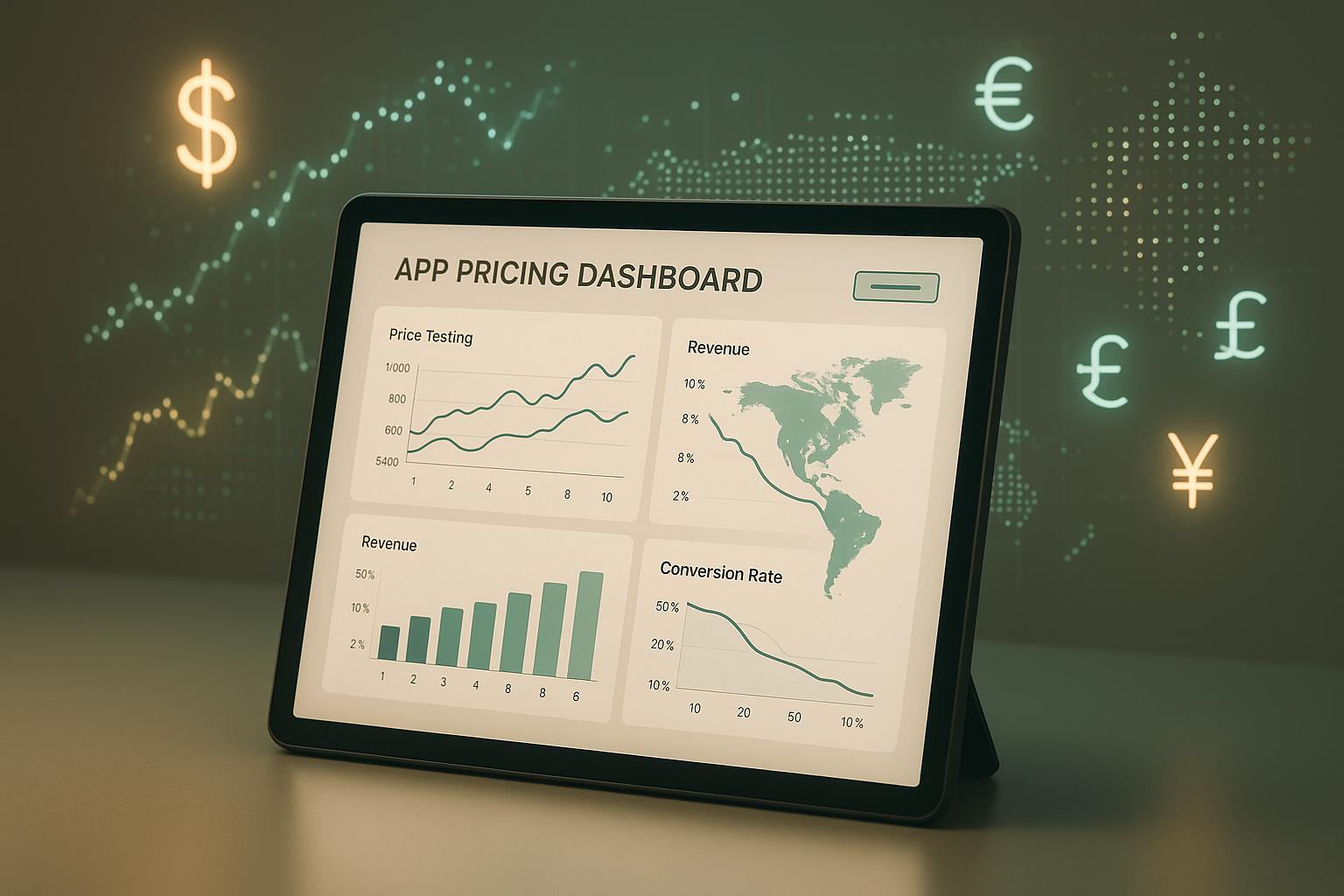
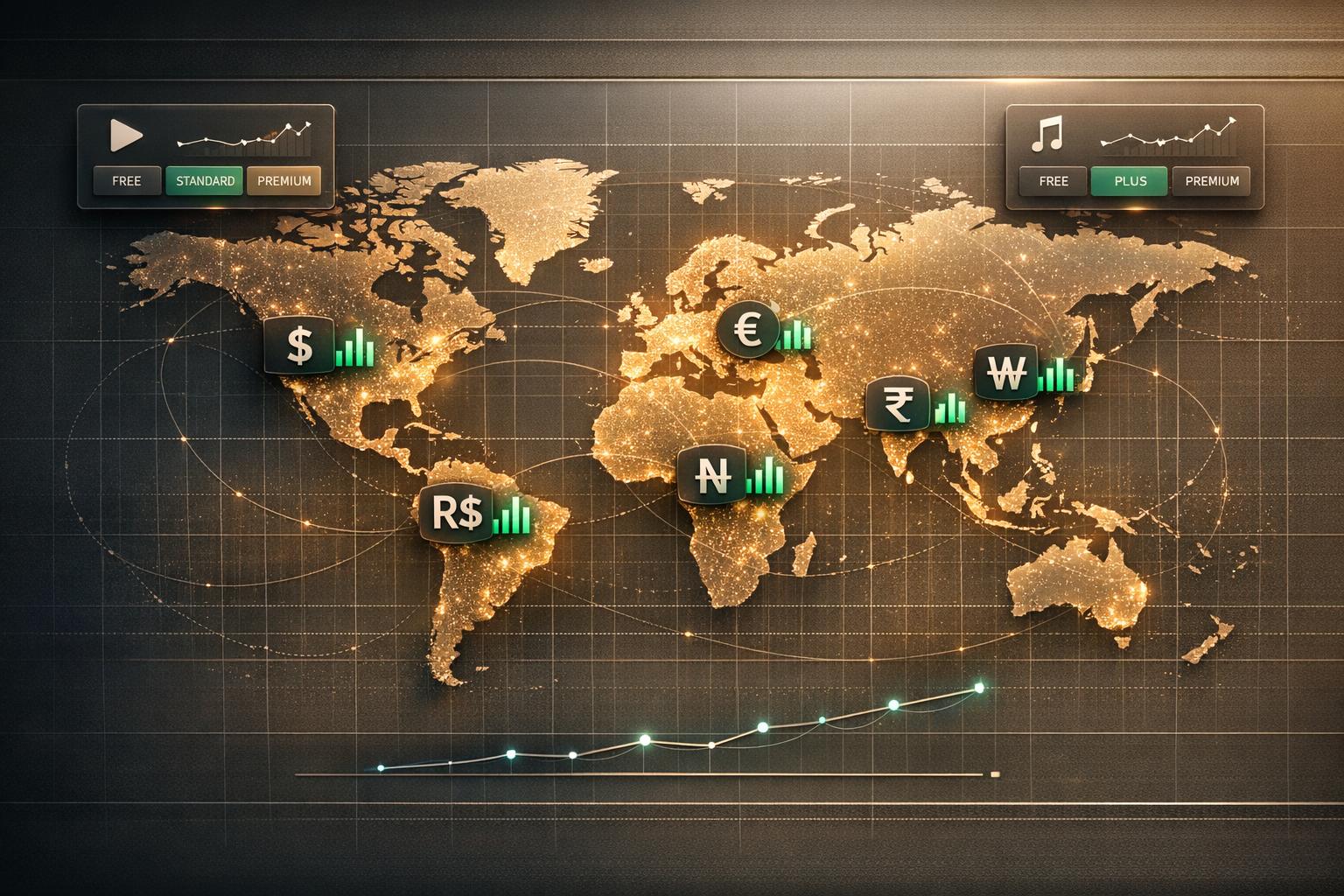
Real-time pricing helps app developers adjust subscription rates dynamically across platforms like iOS, Android, and web. By responding to market factors like currency fluctuations and regional purchasing power, this approach improves affordability, boosts conversions, and maximizes revenue globally. Unlike static pricing models, real-time pricing uses tools like Mirava to recommend optimal price points, ensuring alignment with local economic realities.
Real-time pricing is a high-ROI strategy that doesn’t require new features or engineering effort. By integrating tools like Mirava into your monetization stack, you can expand your app’s reach and optimize global revenue effectively.

Real-Time App Pricing: Integration Workflow & Key Benefits
Apps typically generate revenue through four main models: subscriptions, one-time purchases, consumable in-app purchases, and non-consumable add-ons [1]. Among these, subscriptions - offered on weekly, monthly, quarterly, or annual plans - dominate apps that deliver ongoing value, such as fitness trackers, productivity tools, or language learning platforms. On the other hand, one-time purchases are better suited for utility apps where users can clearly see the value upfront.
The pricing model you adopt plays a significant role in shaping your regional strategy. Subscriptions offer flexibility, allowing you to adjust pricing over time, while one-time purchases establish a fixed value perception that can be challenging to change. For example, Impulse, a brain training app, customizes its plans by market, removing annual subscriptions in Brazil and focusing on weekly and lifetime options to align better with local spending habits [9]. This demonstrates how the pricing model directly influences which regional factors take priority.
Relying solely on currency conversion won’t cut it. A price that seems fair in USD may feel exorbitant - or unusually cheap - in another region. Four critical factors come into play:
| Pricing Input | Metric | Impact |
|---|---|---|
| Currency Exchange (FX) | Market-rate conversion between currencies | A baseline but often results in unaffordable prices in emerging markets [6] |
| Purchasing Power Parity (PPP) | Local income and cost of living | Balances affordability across regions by adjusting for local economic conditions [7] |
| Competitor Benchmarks | Local pricing of similar apps | Helps avoid losing users to cheaper alternatives in the same market [6] |
| Willingness-to-Pay (WTP) | Trial starts, conversions, and churn by country | Determines the maximum price users will pay before conversions drop [5] |
PPP is especially crucial for emerging markets. As Antonio Cappiello, Founder of PricePush, explains:
"Real localized pricing uses Purchasing Power Parity (PPP) as the input, not exchange rates. PPP asks: what rupee number produces roughly the same affordability burden for an Indian user as $19.99 does for a US user?" [7]
Additionally, local price psychology matters. Using rounded amounts that feel familiar - like ₱199 or ₹349 - helps prices resonate better with users [6][7].
No single tool can handle every aspect of pricing. A robust pricing strategy requires two layers working in tandem.
Mirava, positioned as the upstream intelligence layer, calculates optimal pricing by analysing real-time data from major digital platforms. Mirava leverages proprietary indexes built from subscription data (e.g., Netflix, Spotify, Apple, YouTube) to generate region-specific prices for 170+ countries. It automates bulk updates, applies psychological rounding, and previews revenue impact - all without needing code changes or app store review cycles [1][3]. The four key pricing inputs directly feed into Mirava’s calculations, ensuring adjustments align with both market realities and your strategic goals.
Downstream tools like RevenueCat, Adapty, Purchasely, and Superwall handle billing, paywalls, and entitlements. Once Mirava pushes updated prices to platforms like the App Store or Google Play via API, these SDKs automatically apply the new values - eliminating the need for engineering resources [1]. As Demian Voorhagen from RevenueCat puts it:
"Regional pricing is one of the fastest, highest-ROI growth moves available today. You don't need a new feature - you need better economics." [6]
This two-layered approach ensures seamless integration of pricing tools into your monetization strategy, setting the stage for smarter, more efficient revenue management.
The effectiveness of real-time pricing tools hinges on accessing high-quality data. Leading platforms integrate multiple live sources, including foreign exchange (FX) feeds, store-specific metadata, user behavior signals, and tax and policy updates.
FX feeds play a critical role, particularly in high-inflation markets like Turkey and Argentina, where annual currency fluctuations can range between 10% and 30% [7]. Keeping FX rates updated helps prevent what Antonio Cappiello, Founder of PricePush, describes as "silent drift":
"The biggest failure mode with localized pricing isn't the initial setup. It's the silent drift that happens 3, 6, 12 months later." - Antonio Cappiello, Founder of PricePush [7]
In addition to FX data, behavioral signals such as trial-to-paid conversion rates, install trends, and churn metrics - segmented by country and currency - are invaluable. These insights enable pricing tools to shift from reactive adjustments to proactive, data-driven decisions [5]. Platforms like Mirava enhance this approach by combining these inputs with proprietary subscription indexes, generating price recommendations tailored to regional purchasing habits [8].
By leveraging diverse data streams, these tools ensure pricing decisions are both informed and timely.
With a solid foundation of data, real-time pricing tools perform several critical tasks to refine app pricing strategies. Rule-based pricing allows for automated adjustments based on predefined market rules, reducing the need for constant manual updates. Dynamic regional adjustments ensure these rules are applied across all storefronts whenever FX rates or purchasing power indicators change.
Another key feature is psychological rounding, which ensures prices align with local consumer expectations. Unrounded prices, like ₺764.43, can feel unnatural to buyers [7]. Effective tools apply culturally appropriate rounding conventions automatically. Here’s a breakdown of typical rounding practices by market:
| Market | Rounding Convention | Example Price |
|---|---|---|
| United States | .99 endings | $19.99 |
| India | 99 endings on large values | ₹499 or ₹1,499 |
| Japan | Whole hundreds or thousands | ¥1,000 |
| Turkey | Round tens or twenty-fives | ₺99 or ₺125 |
| Brazil | .99 endings with commas | R$19,99 |
Compatibility with major platforms like Apple's App Store and Google Play is also essential. Apple supports about 900 predefined price points per currency, while Google Play allows more flexible, arbitrary local-currency entries [7]. Tools like Mirava simplify this process by enabling bulk updates across 175+ countries, complete with a diff-view preview that estimates revenue impact before changes are implemented [2].
The U.S. plays a central role in global pricing strategies. Both Apple and Google use U.S. prices as the baseline to calculate equivalents for up to 174 other storefronts [10]. This makes it critical to set U.S. prices correctly.
In the U.S., prices typically follow charm pricing conventions (e.g., $4.99, $9.99, $19.99) and are listed as tax-exclusive. Notably, Apple does not automatically adjust U.S. base prices when exchange rates shift [10]. Maintaining logical subscription tier ratios - such as pricing annual subscriptions at 8–10 times the monthly rate - ensures these relationships scale effectively across regions [11].
Additionally, USD serves as the default billing currency in emerging markets where local currencies are unsupported [7]. Platforms like Mirava establish the U.S. baseline, ensuring that global pricing remains competitive when passed through tools like RevenueCat, Adapty, Purchasely, and Superwall.
When selecting a pricing tool, there are some must-have features to consider: global reach, cross-platform compatibility, bulk updates, no-code integration, and diff previews.
Global coverage is essential. The tool should support pricing in over 170 countries, not just the most popular markets. Similarly, cross-platform support ensures seamless management of iOS, Android, and Stripe within one dashboard, eliminating the hassle of juggling multiple admin panels.
Bulk update capabilities are another time-saver. A tool that allows you to push changes across hundreds of storefronts simultaneously avoids the need for tedious manual CSV uploads. Combining this with purchasing power parity (PPP) and willingness-to-pay (WTP) logic enables you to set prices that align with what customers in different regions can afford, rather than relying solely on currency conversion.
Two often-overlooked features can make a big difference: no-code/no-SDK integration and diff previews. A tool that operates directly at the store level reduces reliance on engineering resources and bypasses delays from App Store reviews. Meanwhile, a diff preview - showing the "before and after" pricing for each region - helps prevent errors before changes go live. Additionally, the ability to roll back updates ensures safer experimentation.
Once these features are in place, the next step is integrating the tool into your monetization stack for smooth operation.
To make the most of these tools, place them in two key layers: an upstream pricing intelligence layer and a downstream execution layer. The upstream layer, such as Mirava, determines the best pricing strategies, while the downstream layer - tools like RevenueCat, Adapty, Purchasely, and Superwall - handles the automated execution of those strategies.
Mirava operates as the upstream pricing intelligence layer, feeding its pricing decisions into the downstream tools.
"Mirava updates prices at the store level. Tools like RevenueCat and Adapty read those changes automatically, so your paywalls, trials and entitlement logic stay exactly as they are." - Mirava [1]
Here’s how a typical integration process with Mirava unfolds:
This workflow - from setting rules to live deployment - can be completed without requiring an engineering sprint or waiting for App Store review cycles. The result is a streamlined process that supports ongoing pricing improvements.
A well-organized pricing data model is essential for maintaining consistency and accuracy. Without a solid structure, pricing updates can become chaotic, leading to mismatched tiers and regional errors.
The key is to establish a single source of truth that integrates pricing across App Store, Google Play, and Stripe into one cohesive framework. This unified structure ensures that subscription tiers, like an "Annual Plan", remain consistent across iOS, Android, and web platforms - even if the underlying SKUs differ between stores. From this foundation, you can layer regional overrides for country-specific adjustments, incorporating purchasing power parity (PPP) logic and psychological rounding, all without disrupting the global pricing architecture.
| Data Model Component | Function | Benefit |
|---|---|---|
| Unified SKU Catalog | Syncs iOS, Android, and web products, anchoring regional overrides to a consistent base | Ensures one source of truth across platforms |
| Tier Mapping | Links platform-specific SKUs to a single plan | Delivers a consistent user experience |
| Regional Overrides | Enables per-country price adjustments | Supports PPP and local psychological rounding |
| Event Timeline | Logs all price changes and promotions | Tracks pricing decisions and their impact |
Every pricing adjustment, whether it's a promotional discount, currency exchange update, or regional override, should be logged as a timestamped event. This approach not only makes pricing performance measurable but also allows for quick rollbacks when necessary.
By implementing a unified pricing model, U.S.-based teams can simplify coordination across finance, product, and growth functions, reducing errors and improving efficiency.
For teams based in the U.S., a common challenge is misalignment between departments - particularly product, finance, and growth. When these teams work with inconsistent data, it creates confusion and inefficiencies.
The solution is to centralize pricing analytics, ensuring all stakeholders have access to the same metrics, such as trial conversion rates, ARPPU by region, and currency exchange drift. From there, establish a regular review cadence. Plan to revisit regional pricing two to three times a year to account for factors like currency fluctuations, inflation, and results from past experiments. It's also critical to align promotional pricing across iOS, Android, and web platforms simultaneously. Inconsistent offers across platforms can confuse users and weaken the impact of marketing campaigns.
Another essential workflow is having a rollback protocol. Keep a record of past price tiers so that if a pricing experiment underperforms in a specific market, you can revert quickly without requiring development resources. As Mirava aptly describes it: "Pricing becomes a separate, safer layer your team can manage without shipping code." [1]
Once workflows are aligned, the focus should shift to tracking and refining key metrics to continuously improve your pricing strategy.
To effectively monitor pricing performance, it’s important to look beyond just total revenue. While revenue is important, it doesn’t tell the whole story. For instance, markets like India or Brazil might generate lower absolute revenue but show strong conversion growth after a regional pricing adjustment.
Here are four key metrics to track for a clearer picture:
Localized pricing adjustments can lead to a 15%–40% increase in app revenue [8], while price changes in more price-sensitive markets can drive 15%–30% more trials without additional traffic [3].
As Demian Voorhagen from RevenueCat points out, pricing is about perception: "Value is relative - you're not just competing with other apps, but with the local economy" [6]. When testing price changes, always define a clear control group and test group for specific countries before scaling globally. Additionally, benchmark the top five apps in your category within the local app store to avoid setting prices that are out of step with local expectations [6].
Apple and Google have strict rules governing price changes, particularly for subscriptions. Missteps can lead to policy violations and erode user trust.
Apple mandates user consent for price increases on auto-renewable subscriptions if the hike exceeds 50% of the current price and the difference is more than $5 per period (or $50 annually for yearly plans) [12]. Developers must also provide advance notice before implementing changes: 7 days for weekly subscriptions, 27 days for monthly, and 60 days for annual plans [12]. Additionally, if a subscriber has already faced a price increase for the same subscription within the past 12 months, consent becomes mandatory [12].
| Subscription Duration | Notice Period | Consent Required (U.S.) |
|---|---|---|
| Weekly | 7 days | If >50% increase or >$5 difference |
| Monthly | 27 days | If >50% increase or >$5 difference |
| 2, 3, or 6 Months | 60 days | If >50% increase or >$5 difference |
| Annual | 60 days | If >50% increase or >$50 difference |
Google Play also enforces clear pricing rules. Price experiments are limited to six months, after which prices automatically revert to the original baseline [13]. A mandatory 30-day cool-down period applies before a new experiment can be conducted for overlapping products or regions [13]. If an experiment reaches statistical significance, developers have 14 days to apply the changes manually; otherwise, prices revert to the original [13].
These policies underscore the importance of clear communication and adherence to guidelines to maintain user trust.
Transparent communication is key when updating prices. Adhering to policy requirements while addressing user concerns ensures smoother acceptance of changes. One common pitfall is presenting prices that are purely FX-converted, ignoring local affordability in emerging markets. As Antonio Cappiello, Founder of PricePush, explains:
"FX rates measure how much one currency buys of another in financial markets. They don't measure what an app is worth to someone whose monthly disposable income is a tenth of a US user's." [14]
For instance, a $19.99 base price might translate to ₹1,659.17 in India using FX rates, but this is often 3x to 4x higher than a PPP-adjusted price [14]. Rounded, locally relevant pricing like ₹499 not only feels fairer but also builds trust with users.
When introducing pricing changes, segment updates to clarify whether they apply to new subscribers, specific cohorts, or all users. Existing subscribers should never face unexpected price hikes. In markets with high currency volatility, such as Turkey or Argentina, where values can fluctuate by 10%–30% annually [7], regular checks can help adjust prices and prevent churn due to affordability issues.
Pricing tools that integrate directly with App Store Connect and Google Play Console - without requiring SDK updates or code changes - reduce security risks by avoiding additional vulnerabilities [1]. Robust security practices, such as role-based access controls, ensure only authorized personnel (e.g., Account Holder, Admin, or App Manager) can implement pricing changes [10]. Maintaining a comprehensive audit log of price updates supports accountability for finance and legal teams while enabling easy rollbacks when necessary [3]. Importantly, using aggregated data like installs, trials, and conversions by region, rather than individual user data, helps ensure compliance with GDPR and CCPA standards [5].
Real-time pricing adjustments stand out as one of the most effective tools for app developers aiming to maximize returns. Refining regional pricing often delivers faster and more cost-efficient results compared to developing new features or ramping up ad spend [6]. Time and again, regional strategies have proven their worth by driving significant growth in subscriptions [6].
Transitioning from instinct-based pricing to a data-informed regional approach - one that uses live conversion data, purchasing power parity (PPP), and local pricing psychology - is a hallmark of apps that successfully expand globally. Those that fail to adapt often struggle to grow beyond their home markets. To implement this strategy effectively, follow the checklist below.
To kickstart your real-time pricing strategy, follow these steps:
Mirava simplifies steps 1 through 4 without requiring SDK updates or app binary changes, giving your team control over pricing as an independent layer [1]. Tools like RevenueCat, Adapty, Purchasely, and Superwall automatically sync with updated store prices, ensuring seamless integration across billing, paywalls, and entitlements [1].
Pricing isn’t a set-it-and-forget-it activity. Exchange rates, inflation, and user behavior are constantly shifting, making ongoing review essential for sustained success. Leading teams revisit regional pricing multiple times a year [3]. For example, lowering prices in price-sensitive regions can lead to a 15%–30% increase in trials and paid subscriptions, often with no additional user acquisition costs [3].
By combining Mirava’s dynamic pricing capabilities with platforms like RevenueCat, Adapty, Purchasely, and Superwall, you can stay agile and responsive to market changes.
"Your app should feel made for them, not exported to them." - Demian Voorhagen, Growth, RevenueCat [6]
The ability to make swift, data-driven pricing decisions is what separates the leaders in global app monetization from the rest. Aim for that level of precision and adaptability.
Updating regional prices regularly is key to staying competitive. Aim to review prices every 30 to 90 days. Monthly checks are useful for keeping an eye on currency changes and competitor pricing trends, while quarterly updates help adjust for broader market shifts and economic factors. In fast-changing markets or during notable economic events, you might need to act more quickly - weekly or monthly updates can help you respond to competitor moves or shifts in customer purchasing patterns.
Real-time pricing updates can be implemented without needing to push app updates or go through the App Store review process. These adjustments are handled directly via store APIs and dashboards. However, it’s important to note that official store prices are only refreshed at the store level when users update the app, as specified in the store guidelines.
When adjusting subscription prices, it's essential to follow store guidelines to avoid any compliance issues. Use tools like Mirava to make these updates directly at the store level. These tools streamline the process by requiring manual approval for changes, ensuring that all existing subscriptions, trials, and offers remain intact. Importantly, updates can be implemented without needing changes to SDKs, backends, or entitlements. For current subscribers, their pricing usually remains unchanged unless they are explicitly migrated to the new price with their consent.