Regional pricing for subscriptions is about tailoring prices to match local economic conditions, rather than using flat, global pricing. This approach helps businesses increase revenue, reduce churn, and attract more users in different markets. Here's what you need to know:
Localized pricing helps businesses grow faster in emerging markets and improves long-term revenue by aligning prices with customer expectations.
Setting regional subscription prices isn’t as simple as converting currencies. To get it right, you need to factor in both Purchasing Power Parity (PPP) and the broader market landscape.
Purchasing Power Parity (PPP) measures how much a currency can buy in terms of a standard basket of goods [4][6]. It’s a tool that helps businesses set local prices based on economic realities rather than just exchange rates [1].
The gap between market exchange rates and PPP can be striking. For example, India’s nominal GDP per capita is around $1,965, but when adjusted for PPP, it jumps to about $7,197 [4]. Similarly, Switzerland’s price levels are 127% of U.S. prices for the same goods, while Turkey’s are just 31% [4].
Knowing how to set up PPP pricing as a guide can lead to impressive results. Companies that price according to local purchasing power have seen revenue increases of 20% to 40% outside the U.S. A study of 457 SaaS companies even found an 11% month-over-month growth when pricing was localized to market conditions [5]. For instance, a $9.99 subscription in the U.S. might translate to ₹249 in India when adjusted for PPP, which is far more accessible than a simple exchange rate conversion [1].
Once you’ve established a PPP-based baseline, you can fine-tune pricing by considering additional market factors.
PPP is just the starting point. Other elements like taxes, currency stability, competition, and customer acquisition costs play a big role in shaping pricing strategies.
1. Taxes and Fees
Local taxes, such as VAT or GST, can significantly inflate prices. Even a small miscalculation - say, 15% - can wipe out profits [1][2]. For example, while Apple’s recommended pricing in India is only 21% lower than U.S. prices, many apps succeed by pricing 50–80% lower to align better with local purchasing power [2].
2. Currency Volatility
Exchange rate fluctuations add another layer of complexity. Platforms like Apple and Google adjust prices to stabilize revenue, but this doesn’t always reflect the value customers perceive. If the local currency devalues, rigid exchange rate pricing can hurt retention. PPP rates, on the other hand, tend to remain more stable since they’re less influenced by market speculation or central bank policies [4].
3. Competition and Acquisition Costs
Local competitors often have a better grasp of price sensitivity in their markets. For instance, in Brazil, lower customer acquisition costs can balance out reduced subscription prices, allowing companies to maintain healthy profit margins [2]. Understanding these dynamics can give you an edge.
"A system that's focused entirely on business mechanics [like taxes and exchange rates], with no regard for customer value, was never going to succeed long-term." – Jacob Rushfinn, Founder, Rushfinn Consulting [2]
To succeed, start with trustworthy PPP data from sources like the World Bank or OECD. Experiment with different price points to find the sweet spot [1]. Don’t forget to set a minimum price floor that covers local taxes and platform fees [5]. And finally, think beyond numbers - use the correct currency symbols, date formats, and payment methods to build trust with your audience [7].
Once you're familiar with purchasing power parity and the nuances of different markets, it's time to turn that understanding into actionable strategies. Optimizing regional pricing involves breaking down markets, conducting research, and experimenting with pricing models.
Start by grouping countries into economic tiers based on purchasing power and customer behavior. Look at conversion rates and ARPU (average revenue per user) across regions to identify pricing gaps. For instance, if conversion rates in India are much lower than in the U.S., it could signal a pricing mismatch. Keep an eye on local competitors and double-check app store pricing to ensure you're aligned with regional standards. Factor in local costs like taxes and advertising expenses, as well as how people perceive value in each region. For example, European users often prefer weekly plans, while shorter, low-cost subscriptions are more common in areas with lower purchasing power.
Here’s a basic tiering strategy:
Take India as an example: while Apple suggests reducing prices by 21%, many successful apps in the region go further, cutting prices by 50–80% to meet local demand [2][3]. These tiers help you gauge how much users in different regions are willing to spend.
Once you've segmented your markets, the next step is understanding how much customers are willing to pay. Tools like the Van Westendorp Model can help you find the sweet spot for pricing by identifying acceptable price ranges [2][9]. Another option is the Gabor-Granger Technique, where users are asked if they'd pay a specific price, and adjustments are made based on their responses [9]. Combine insights from these tools with competitor pricing and your own conversion data.
A great example of this approach is Flo's pricing experiments in Brazil during 2024–2025. By significantly lowering subscription costs, Brazil became its third-largest market, driving an 80% growth rate in non-English-speaking regions [2]. Similarly, running A/B tests with significant price variations (e.g., $39 vs. $69) in your primary market can reveal how sensitive customers are to price changes [2].
The final step is to validate your pricing strategy through controlled experiments. Focus on one region at a time, running tests for 2–4 weeks to account for different purchasing cycles. Keep pricing as the only variable to ensure accurate results [10][1][11]. While short-term conversion spikes can be tempting, prioritize metrics like RPU (revenue per user) and LTV (lifetime value) for a clearer picture of long-term success [1][2]. Keep monitoring results over time to rule out any temporary effects from novelty [11].
Localization also plays a big role. Test elements like currency symbols and regional payment methods (e.g., UPI in India or Pix in Brazil) to make transactions smoother [1][7]. Spotify, for instance, localized its premium subscription pricing in India to ₹119 per month, compared to $10.99 in the U.S., helping it capture 31% of the market. Companies that adopt strategic regional pricing often see 18% faster growth and 25% higher revenue per customer [1][8].
Managing regional pricing across dozens of countries can be a daunting task if done manually. Automation tools make this process faster and more accurate by allowing you to update prices in bulk across multiple regions in just minutes [13]. These tools also provide revenue simulations, letting you preview how potential pricing changes could impact metrics like ARPU (Average Revenue Per User) and lifetime value [16][17].
Another key advantage is ensuring compliance with regional regulations. Automation platforms take care of complexities like VAT, GST, and sales tax variations, while also helping you adhere to data privacy laws such as GDPR in Europe or CCPA in California [16]. This reduces the risk of penalties and keeps your operations running smoothly. Additionally, these tools apply psychological pricing automatically - adjusting prices to end in .99 for North America or .95 in other regions based on local buying behaviors. This simple tweak can boost conversions by 15–20% [12][13].
Frequent pricing adjustments can make a big difference. SaaS companies that revise their pricing quarterly report up to 4x more ARPU growth over five years compared to those that update annually [16]. Even a small improvement - like a 1% increase in monetization through better regional pricing - can boost your bottom line by as much as 12.7% [16].
These automation capabilities pave the way for tools like Mirava, which integrate all these features into a unified pricing solution.
Mirava takes regional pricing to the next level by combining Purchasing Power Parity (PPP) data with local market insights. Using its Willingness-To-Pay (WTP) algorithm, Mirava analyzes demand signals to recommend competitive pricing tiers for iOS, Android, and web platforms [13]. This ensures your pricing strategy is not only automated but also optimized for each market.
With Mirava, you can set pricing rules once and apply updates across platforms like the App Store, Google Play, and Stripe simultaneously. Prices for over 175 countries can be adjusted with a single click - no need for SDK updates or lengthy engineering efforts [13][15]. The platform also offers revenue previews, so you can see the potential impact of pricing changes before rolling them out [13]. On average, Mirava users report revenue increases of 15% to 40% through better localized pricing [13].
"Mirava helped us increase our global revenue by 40% in just 3 months. The WTP pricing strategy was a game-changer for our subscription plans." – Ethan Ross, Founder of Calmi [13]
Mirava also handles psychological rounding automatically and keeps an eye on currency fluctuations, ensuring your revenue isn’t negatively affected by static pricing during market shifts [13][14].
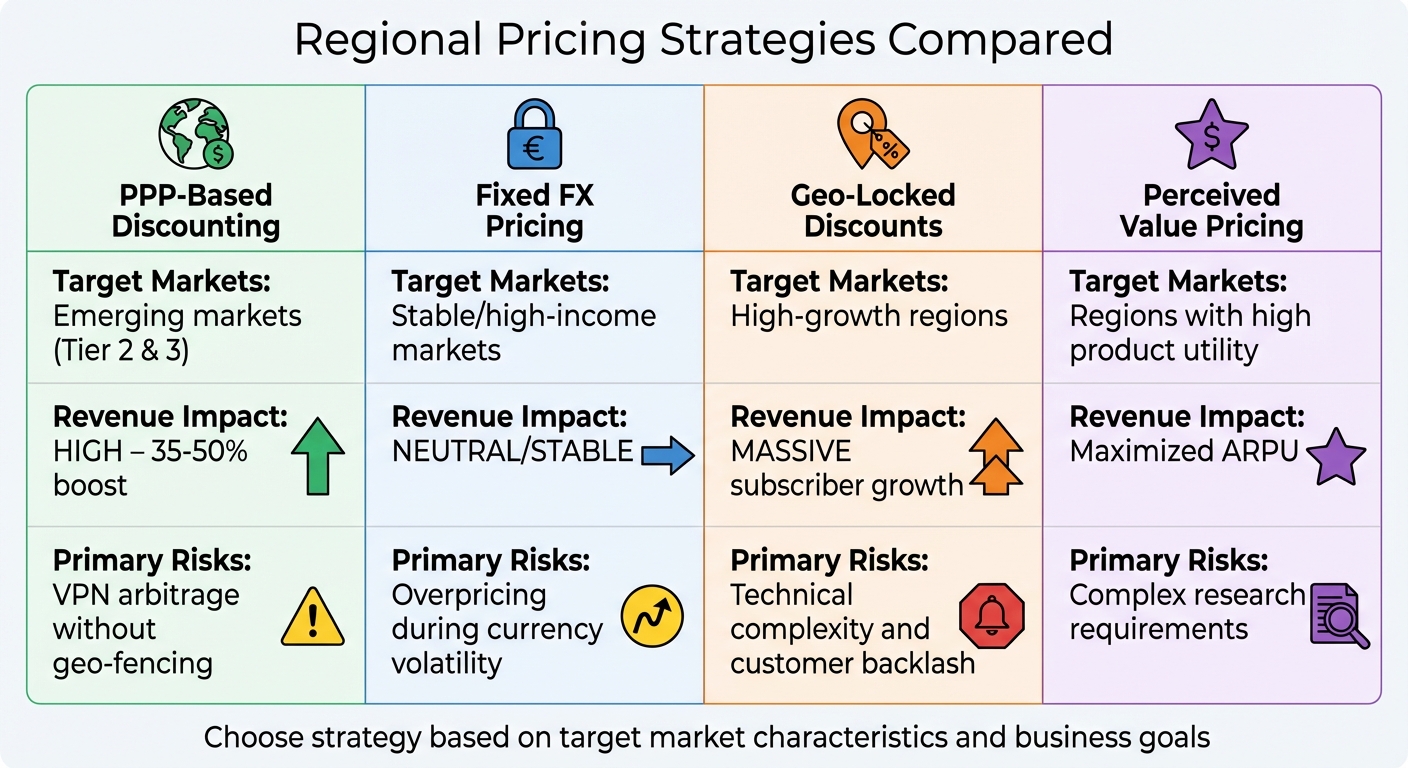
Regional Pricing Strategies Comparison: Revenue Impact and Risk Assessment
Different regional pricing strategies come with their own sets of benefits and challenges. The right approach depends on your business goals and the specific markets you're targeting.
PPP-based discounting is particularly effective in emerging markets like India or Brazil, where it can boost revenue by 35–50%. That said, without proper geo-fencing, this strategy opens the door to VPN arbitrage, which can undercut profits [2][18].
Fixed FX pricing works well in stable, developed markets such as the US or UK. By locking in prices, it shields profit margins from currency fluctuations. However, this approach can backfire in unstable economies where currency devaluation might make prices uncompetitive [18].
Geo-locked discounts are ideal for rapidly growing regions. By offering steep discounts, businesses can quickly capture market share. However, this strategy demands robust technical safeguards to prevent misuse and avoid upsetting customers if the discounts are discovered outside the intended regions [2][18].
Perceived value pricing adjusts rates based on how valuable a product is in a specific region. For example, language learning apps might charge more in areas where bilingual skills are highly valued for career advancement. While this approach can significantly increase revenue per user, it requires deep local research to understand what drives value in each market [2].
| Strategy | Target Markets | Revenue Impact | Primary Risks |
|---|---|---|---|
| PPP-Based Discounting | Emerging markets (Tier 2 & 3) | High (35–50% boost) | VPN arbitrage without geo-fencing |
| Fixed FX Pricing | Stable/high-income markets | Neutral/Stable | Overpricing during currency volatility |
| Geo-Locked Discounts | High-growth regions | Massive subscriber growth | Technical complexity and customer backlash |
| Perceived Value Pricing | Regions with high product utility | Maximized ARPU | Complex research requirements |
These strategies emphasize the importance of aligning pricing with market conditions. Automation tools can help implement such strategies quickly, ensuring your pricing stays competitive and responsive across regions.
When testing these approaches, focus on noticeable price differences - such as $39 versus $69 - rather than minor adjustments. This helps provide clearer insights into price elasticity [2]. Additionally, track long-term metrics like lifetime value and retention instead of just short-term conversion rates. Lower prices may initially attract more users but could lead to higher churn if they don’t match the product’s perceived value [2].
Tracking the right metrics is essential to determine if your regional pricing strategy is hitting the mark. Start with ARPU (Average Revenue Per User) - this helps you see how much revenue each user brings in across different markets. If you’ve implemented localized pricing, you should aim for a 3–5x increase in underperforming regions [7]. Next, measure Lifetime Value (LTV) to assess long-term performance. A solid regional pricing strategy can lead to a 25–40% boost in LTV for localized markets [7].
Conversion rates are another critical indicator. If your prices align with local purchasing power, you could see conversion rates improve by 70% or more in price-sensitive regions [7]. Meanwhile, retention rates tell you if users view your pricing as fair. Lower churn rates are a strong sign that your pricing matches the local economic context [7].
"Value isn't universal - it's relative. You're not just competing with other apps, you're competing with the local economy." – Demian Voorhagen from RevenueCat [19]
To dig deeper, segment your data by region. This helps uncover gaps where high traffic doesn’t translate into checkouts [7]. Keep an eye on average order value (AOV) and refund rates to identify any unintended side effects of your pricing changes [7]. Together, these metrics can confirm whether your pricing strategy is driving revenue growth effectively [12].
Once your metrics show success, scaling becomes the next challenge. Managing pricing manually for over 175 countries is simply not feasible. Automation is the solution - it handles currency adjustments and batch updates seamlessly across platforms like iOS, Android, and web [7]. Choose a system that supports multiple currencies and local payment methods. Avoid custom integrations that may complicate your operations and slow down implementation [7].
Platforms like Mirava make scaling easier by using PPP-based indices to set accurate subscription prices. With just one click, you can update hundreds of prices. Mirava also offers pricing experiments with A/B testing tools and features like team collaboration and approval workflows. These tools ensure you can scale your pricing strategy without losing control or accuracy.
Regional pricing works best when grounded in three main strategies.
First, base your pricing on Purchasing Power Parity (PPP) rather than just currency conversion. This approach ensures that a price like $9.99 feels consistent across different economies, reflecting local buying power.
Second, embrace systematic pricing tests. Use controlled A/B experiments with three variations per region: a PPP-based baseline, a premium option priced 20% higher, and a volume option priced 20% lower[1]. This helps fine-tune pricing for optimal results.
Third, automate your pricing processes. Trying to manually manage prices across 175+ countries is a recipe for errors and missed chances. Tools like Mirava simplify this by automating PPP syncing, batch updates, and tax compliance. With just one click, you can update hundreds of prices while ensuring team collaboration and approval workflows remain intact.
Additionally, tailor payment methods and pricing formats to local norms. Offer familiar payment options and use psychological pricing cues like $.99 or $.49[1][20]. Set a price floor to protect your margins, and prioritize regions with high traffic but low conversions - these are often untapped opportunities[1].
Track key metrics like Revenue Per User (RPU), supported by insights into customer lifetime value and retention rates[1]. Implement changes gradually through phased rollouts to reduce risks and confirm results before going all-in. Companies that have adopted localized pricing strategies have seen impressive outcomes, including 11% month-over-month growth, tripled Annual Recurring Revenue, and a 60% drop in refund rates[5].
Purchasing Power Parity (PPP) is a pricing concept that adjusts costs based on the buying power of currencies across different markets. By taking local economic conditions into account, PPP ensures prices feel fair and accessible to customers, no matter where they are.
When businesses use PPP in their regional pricing strategies, they can set prices that match the local purchasing power. This approach not only helps avoid overpricing or underpricing but also creates a better experience for customers. Plus, it can open doors to new markets and increase revenue by making products or services more appealing globally.
Automation tools for regional pricing bring several important benefits to the table. They allow for precise and flexible price adjustments by considering factors like currency fluctuations, local buying power, and competitive landscapes. This helps ensure pricing is both fair and competitive across regions, which can lead to better conversion rates and increased revenue.
These tools also streamline the process of managing pricing in multiple markets. By automating tasks like price updates and compliance, businesses can save time and reduce the likelihood of manual mistakes. This means developers can dedicate more energy to scaling their business instead of juggling intricate pricing details.
On top of that, automation enables real-time updates and testing, making it easier to respond quickly to market changes and shifts in consumer behavior. This adaptability keeps pricing strategies effective and aligned with both global trends and local conditions, creating a solid foundation for growth.
To fine-tune regional subscription prices, start by using purchasing power parity (PPP) as a guide. PPP helps you set baseline prices that match local economic conditions, going beyond simple currency conversions. This ensures your pricing feels fair and aligns with what customers in each region can afford.
After establishing these baseline prices, dive into A/B testing. Experiment with different price points in specific regions and track key metrics like conversion rates, churn, and customer lifetime value (LTV). This step helps uncover the price points that strike the right balance between revenue growth and customer retention.
For a more seamless process, tools like Mirava can be game-changers. They automate regional price adjustments, keep an eye on currency fluctuations, and ensure compliance with local regulations. Combining these tools with a data-driven approach allows you to fine-tune pricing strategies, saving time while driving revenue growth across a variety of markets.