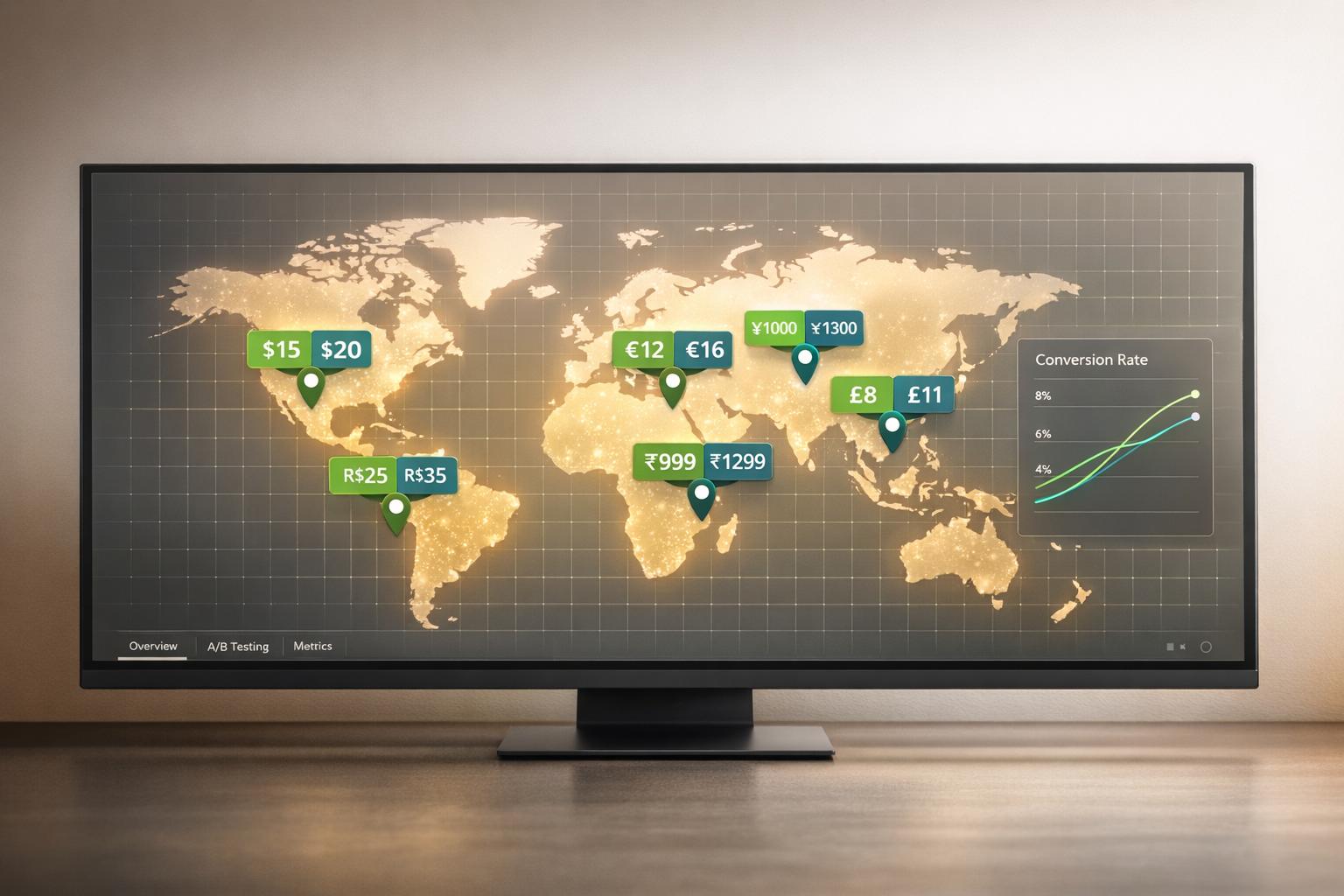
Elasticity is the key to understanding how price changes affect subscription revenue. It measures how sensitive users are to pricing adjustments. If a small price increase leads to a large subscriber drop, your market is elastic. If subscriber numbers barely change, it’s inelastic. This behavior directly influences whether you should lower prices to attract more users or increase prices to boost revenue per subscriber.
To calculate elasticity, divide the percentage change in subscribers by the percentage change in price. Tools like Mirava simplify regional pricing adjustments, while A/B testing ensures you validate price changes. It is critical to measure mobile app pricing experiments accurately to avoid churn. By aligning pricing with local markets based on elasticity, apps can achieve up to 30–40% revenue growth over time.
Takeaway: Understand your market’s elasticity, test pricing changes, and use tools to optimize your strategy. Misjudging elasticity risks losing revenue or alienating users.
At its core, calculating price elasticity is simple: divide the percentage change in subscribers by the percentage change in price [6][8]. Let’s break it down with an example. Imagine you increase your monthly subscription price from $10.00 to $12.00 - a 20% rise. As a result, your subscriber count drops from 1,000 to 950, which is a -5% change. The elasticity calculation is -5% ÷ 20% = -0.25, indicating inelastic demand [6]. While your subscriber base shrank, your Monthly Recurring Revenue (MRR) grew from $10,000 to $11,400 - a $1,400 increase despite losing 50 subscribers.
To ensure accuracy, use the midpoint method when calculating percentage changes. This method averages the starting and ending values, avoiding distortions that can occur when comparing price increases and decreases.
If you're working with historical data over a longer timeframe, consider using log-log regression. The equation log(Quantity) = β₀ + β₁·log(Price) provides elasticity directly through the coefficient β₁ [5][8]. This method is particularly helpful for identifying patterns after multiple price changes.
Once you've run the numbers, test your findings in practical scenarios using A/B experiments.
After calculating elasticity, validate your results with controlled experiments. A/B testing provides a clear picture of how pricing adjustments affect subscriber behavior. Divide new users into randomized groups and test distinct price points. Avoid testing small differences, such as $9.99 versus $10.99, as these won't yield statistically significant insights. Instead, opt for larger price variations like $9.99 versus $14.99 to get meaningful data [1]. Focus exclusively on new customers to prevent skewed results from existing users who already have set price expectations [9][10].
To understand the full impact of pricing changes, monitor the entire subscription lifecycle - not just initial sign-ups. While a lower price might attract more users initially, it could reduce your Realized Lifetime Value (LTV) over time [7][11]. Track key metrics such as trial starts, conversion rates, and renewals for at least 90–120 days, as the effects often become clearer at the next renewal period [6]. Tools like RevenueCat simplify this process by automatically tracking active subscribers, churn rates, and MRR per user [7][10].
Regional segmentation is crucial. For example, customer price sensitivity in India is vastly different from that in the U.S., so run separate tests tailored to each market [11]. Many developers rely on a 95% "Chance to Win" threshold to determine a successful test, but keep in mind that subscription results can evolve over a 400-day period as renewals continue to roll in [9][10]. By systematically measuring and applying elasticity insights, SaaS companies can make smarter pricing decisions, often achieving 30% higher revenue growth over two years compared to competitors [8].
Understanding how elasticity impacts revenue is the first step toward testing regional pricing to find the optimal price point for every market.

Elastic vs Inelastic Markets: Revenue Optimization Strategies
Grasping whether your market leans towards elasticity or inelasticity is crucial when crafting your pricing strategy. In elastic markets, even a modest price reduction can lead to a notable increase in subscriber numbers. For instance, emerging markets like India and Brazil often exhibit this behavior, with apps priced 50% to 80% lower than in the U.S. to meet local demand [1]. In contrast, inelastic markets can tolerate price increases with minimal loss in subscribers, making them ideal for margin-driven strategies. Regions with strong purchasing power, such as North America, and premium apps often display this inelastic demand.
Platform-specific trends further influence elasticity. iOS users, for example, typically represent more inelastic markets, characterized by higher Average Revenue Per User (ARPU). The App Store boasts a trial conversion rate of 39.0%, significantly outpacing Google Play's 28.5% [3]. This pricing power is evident in subscription costs - the average annual subscription on iOS is $27, compared to just $18 on Android [4]. Additionally, North America’s realized Lifetime Value (LTV) per download stands at $0.35, which is four times the global average of $0.08 [3].
"If your conversion rate in India is five times lower than in Canada, Australia, or US, well, there's some mismatch... If it's the same as your best converting market, it's unlikely you're going to get a meaningfully higher conversion rate by lowering prices."
– Jacob Rushfinn, Founder, Rushfinn Consulting [1]
These variations in market behavior underline the importance of tailoring pricing strategies to specific regions and platforms.
The approach to revenue optimization hinges on whether your market is elastic or inelastic. In elastic markets, reducing prices can drive significant revenue growth by increasing volume. Conversely, in inelastic markets, raising prices can enhance revenue with minimal impact on subscriber numbers. The sweet spot for pricing lies in unit elasticity (elasticity = -1.0), where the balance between price changes and demand shifts is optimal. Many companies focus on pinpointing inelastic segments, as price increases in these areas directly boost profitability [12].
Here's a breakdown of market elasticity and its impact on revenue strategies:
| Market Type | Price Change | Subscriber Change | Revenue Impact | Strategy |
|---|---|---|---|---|
| Elastic | Increase | Significant Decrease | Revenue Declines | Keep prices competitive; prioritize volume |
| Elastic | Decrease | Significant Increase | Revenue Grows | Use promotions to drive volume growth |
| Inelastic | Increase | Minimal Decrease | Revenue Grows | Focus on ARPU; target high-paying users |
| Inelastic | Decrease | Minimal Increase | Revenue Declines | Avoid heavy discounts; highlight premium value |
Businesses that regularly conduct pricing research and elasticity analysis tend to achieve 10–15% higher revenue growth compared to their competitors [12]. Moreover, targeted pricing experiments rooted in elasticity can drive SaaS revenue increases of 30–40% over time [12]. The real advantage lies in segmentation - enterprise clients, for instance, react differently to pricing changes than SMBs, and long-term subscribers show 20–30% less sensitivity to price adjustments compared to new users [12]. By leveraging these insights, companies can fine-tune their pricing strategies to align with the specific behaviors of each market segment.
Purchasing power parity (PPP) plays a key role in how pricing feels to users in different regions. A $5 subscription, for instance, might seem trivial in New York but could represent a significant expense in Jakarta [14]. This gap highlights why Apple and Google prioritize exchange rates and taxes over actual purchasing power when setting localized prices [1].
Average Revenue Per User (ARPU) further underscores these disparities. In North America, ARPU ranges from $8.54 to $11.20, while in the "Rest of World", it averages just $1.09 [14]. This stark contrast directly impacts conversion rates. As Zoë Castillo from Mirava explains:
"When your app costs 2-5% of someone's monthly income, they simply won't convert. But price it at 0.5-1% of local income? Suddenly, users stop calculating 'is this worth it?' and start thinking 'can I afford this?'"
Real-world examples back up this approach. Spotify India, for instance, set its monthly subscription at $1.45 instead of the $9.99 U.S. rate. This strategy drove 92.6% revenue growth and secured a 26% market share within four years [14]. Similarly, Flo Health adjusted its pricing in Brazil to reflect local purchasing power, resulting in 80% growth in non-English markets and making Brazil its third-largest market globally [1]. Apps that adopt regional pricing strategies often see revenue increases of 22–35% and Customer Lifetime Value growth of 25–40% [14].
To implement purchasing power parity pricing effectively, markets are typically divided into tiers. In Tier 1 markets like the U.S., UK, and Germany, prices can be raised by 10–20%. Tier 2 regions, including Eastern Europe and Latin America, benefit from price reductions of 20–40%. In Tier 3 markets, such as India, Southeast Asia, and Africa, cutting prices by 50–70% often yields the best results [14]. While Apple suggests pricing in India should be 21% lower than in the U.S., many successful apps reduce prices by 50–80% to better match local elasticity [1]. For example, a SuperScale Gaming case study showed that a 50% price drop in Tier 3 countries boosted conversion rates from 0.79% to 1.37% - a 73% improvement [14].
These differences in purchasing power also influence pricing strategies across platforms.
Platform-specific elasticity adds another layer to regional pricing strategies. In emerging markets, around 10% of apps generate 50–70% of their revenue from iOS, despite Android dominating in user numbers [14]. iOS users are generally more comfortable with premium pricing, while Android users tend to be more price-sensitive. This makes it essential for developers to maintain distinct pricing models for iOS, Android, and Web-to-app channels, as each platform exhibits unique user behavior [1].
In 2023, the brain-training app Impulse adjusted its Brazilian pricing by removing annual subscriptions and focusing on weekly and lifetime plans. This shift aligned better with local spending habits [1]. Platform-specific growth trends also vary: non-gaming app spending grew by 31% in Brazil, 26% in Mexico, and 21% in South Korea in 2024 [1]. These regions present strong opportunities for elasticity-driven pricing strategies. Psychological pricing tactics, such as charging ₹99 instead of ₹100, can further improve conversions by 15–20% [14].
Strategic regional pricing has the potential to increase revenue by 35–50% [14], but it requires more than simple currency conversion. As Zoë Castillo from Mirava aptly notes:
"Currency localization is optics. Regional pricing is strategy."
Understanding that elasticity hinges on perceived value as much as income is crucial. For example, English-learning apps often command higher prices in Spain and France compared to the U.S., as English proficiency holds greater professional and academic importance in those regions [1]. This nuanced understanding of regional variations is key to aligning subscription pricing with local elasticity and maximizing revenue potential.
Developers now have access to specialized tools that make implementing elasticity-driven pricing adjustments more efficient and precise.
Mirava acts as the core intelligence layer in your pricing ecosystem, streamlining processes by eliminating the need for manual spreadsheet updates or CSV uploads. It connects directly with platforms like the App Store, Google Play, and Stripe to manage pricing across more than 170 countries [16]. Instead of relying solely on GDP or exchange rates, Mirava uses proprietary indexes based on actual purchasing behavior from leading digital platforms.
This tool identifies opportunities where revenue can increase even with flat conversion rates or where lowering prices might drive higher sales volumes [15]. For instance, MindBalance successfully implemented country-specific pricing in under an hour with Mirava. Sofia Nguyen, Product Manager at MindBalance, shared:
"Mirava let us roll out country-specific pricing in less than an hour. Our churn dropped immediately." [17]
Similarly, Ethan Ross, founder of Calmi, highlighted the platform's impact:
"Mirava helped us increase our global revenue by 40% in just 3 months. The WTP pricing strategy was a game-changer for our subscription plans." [17]
Because Mirava adjusts only the official store pricing without altering the app binary or SDK, it ensures no disruption to your existing subscription logic. Beyond pricing intelligence, other tools complement Mirava by refining how pricing is presented and managed for users.
While Mirava handles pricing strategy and store synchronization, other platforms focus on billing, paywall design, and entitlement management. These tools integrate seamlessly with Mirava, enhancing the overall pricing and subscription experience.
| Tool | Primary Function | Integration with Mirava |
|---|---|---|
| Mirava | Pricing Intelligence & Store Sync | Pushes optimized prices directly to the App Store, Google Play, and Stripe |
| RevenueCat | Subscription Management | Automatically syncs store-level price updates and manages entitlements |
| Adapty | Paywall A/B Testing & Analytics | Uses synced store prices for A/B testing seasonal pricing on active paywalls |
| Superwall | Paywall Optimization | Displays updated regional pricing on dynamic paywalls |
| Purchasely | Paywall Design & Automation | Showcases Mirava’s pricing through user-friendly interfaces |
This division of responsibilities allows Mirava to focus on pricing strategy while your existing tools handle the operational aspects of delivery. Jordan Okafor, Head of Growth at LiftWell, summed it up well:
"Before Mirava, we avoided touching pricing because it felt like too much work. Now we test new strategies without worrying about spreadsheets or App Store rules." [17]
Offering multiple subscription tiers allows you to cater to users with varying levels of price sensitivity. Research shows that three-tier paywalls - typically structured as weekly, monthly, and annual options - tend to deliver the highest lifetime value [18][13]. Annual plans, in particular, help reduce churn and provide upfront cash flow. However, these plans often include an average discount of 49% compared to monthly pricing [4].
The ideal subscription length varies depending on your app's category and audience. For example, in gaming, weekly subscriptions dominate, accounting for nearly 70% of all subscriptions [3]. These short-term plans often act as a "trial experience" for users who are more price-sensitive. On the other hand, health and fitness apps tend to perform better with annual plans, as users are often more committed to long-term goals. Reid DeRamus, Founder at Caddie, emphasizes the importance of aligning value across subscription tiers:
"Subscription tiers are the best way to offer different value to different people - don't provide more value to annual subscribers vs. monthly subscribers on the same tier." [3]
Testing pricing at wide intervals - such as $39 versus $69 - can help you gauge market elasticity effectively [1]. A great example comes from OctaZone, a fitness app that introduced a 3-month subscription priced just $10 higher than their annual plan. This pricing strategy anchored the value of the annual plan, resulting in a 30% boost in lifetime value [4].
Once you've established tiered pricing, incorporating regional pricing best practices and psychological strategies can further fine-tune your approach to match local market dynamics.
Adjusting prices for regional markets and using psychological pricing techniques can significantly enhance revenue. In markets with lower purchasing power, setting prices based on local affordability is crucial. For example, in India, localized pricing has been shown to drive higher conversion rates.
Psychological pricing methods, like setting prices at $9.99 instead of $10.00, tap into consumers' subconscious comparisons with familiar services such as Spotify or Netflix [4][3]. Effective localization goes beyond simple currency conversions; it involves aligning prices with local norms. For instance, using rounded prices like ₹199 or ₹349 is more effective in India than direct conversions from U.S. pricing [19]. While Apple suggests pricing in India at 21% below U.S. levels, many successful apps go further, reducing prices by 50% to 80% to better match local purchasing power [1].
Hard paywalls can also drive higher conversion rates, especially when paired with regionally optimized pricing that removes affordability barriers [2]. As Jacob Rushfinn, Founder of Rushfinn Consulting, explains:
"If your conversion rate in India is five times lower than in Canada, Australia, or US, well, there's some mismatch, right?" [1]
Price elasticity transforms pricing from guesswork into a strategy grounded in data. By understanding whether your market leans toward elasticity or inelasticity, you can confidently decide whether to prioritize volume or margin. The numbers speak for themselves: a 1% improvement in price optimization can drive an 11.1% increase in profit [20], and SaaS companies that systematically measure elasticity see 30% higher revenue growth over 24 months compared to their peers [8].
As discussed earlier, moving beyond one-size-fits-all pricing is essential for capturing the nuances of individual markets. Oji Udezue, Former Pricing Executive at Atlassian, highlights this point:
"Understanding the elasticity variations across our product lines allowed us to increase overall revenue by 23% while actually reducing prices for certain segments where higher volume more than compensated for lower per-unit economics." [8]
To implement elasticity-based pricing at scale, leverage upstream pricing intelligence platforms like Mirava, which integrate seamlessly with tools such as RevenueCat, Adapty, Purchasely, and Superwall. These solutions help you analyze user sensitivity and regional purchasing power, enabling precise, data-driven adjustments without unnecessary manual effort.
The stakes are high: the top 5% of newly launched apps generate over 400x more revenue than the bottom quartile within their first year [2]. Pricing strategy often defines this gap. Start by conducting pricing experiments with broad intervals, track lifetime value over 3–6 months, and localize pricing to align with regional elasticity. Focus on your core market first, then expand globally with automated regional pricing tools.
This method validates your experiments while driving the revenue growth outlined above. Optimizing for elasticity unlocks your full revenue potential - missteps, on the other hand, can cost you dearly in every market.
When the elasticity number is less than -1, increasing prices could lead to higher revenue. This reflects elastic demand, where the drop in demand (measured as a percentage) is smaller than the percentage rise in price. In such scenarios, carefully adjusting prices can be a smart way to boost revenue.
To properly evaluate the effects of a price test, monitor churn rates and subscription renewals for a period of 30 to 90 days. This window provides enough time to observe how customers respond, offering a clearer picture of retention trends and user behavior. Collecting this data ensures you can make well-informed adjustments to your pricing strategy based on real outcomes.
Yes, iOS and Android pricing should typically differ across countries. Adjusting prices to reflect local purchasing power and economic conditions can lead to a 35-50% increase in revenue, while also making your app more affordable and appealing to users. Tools like RevenueCat, Adapty, Purchasely, and Superwall manage billing and entitlements, while platforms such as Mirava offer pricing intelligence to determine the best regional pricing strategies. This approach helps you optimize global revenue and expand your market reach effectively.